Creator logic-in-practice
In today’s media environment characterized by algorithmically governed platforms like TikTok, publics are no longer primarily organized through social networks that have defined earlier platforms like Facebook and Twitter. Instead, visibility is increasingly allocated by algorithmic predictions of what will capture attention in the moment. Drawing on a year-long digital ethnography on TikTok and interviews with progressive political content creators and communications strategists, this book project investigates how influence is enacted and translated into political power in what Lee conceptualizes as the post-networked era—where networks still exist but their organizing force is eclipsed by opaque algorithmic platform infrastructures.
Extending Bourdieu’s logic of practice, Lee introduces the framework of creator logic-in-practice, treating creators as fielded actors whose practices take shape in relation to one another while contending with constantly evolving and overlapping forces of algorithmic pressures, political opportunity structures, and commercial imperatives. Beginning with the structural focus on the field of social media production, where attention capital has become the dominant force, the analysis moves inward to examine how creators navigate the field demands that often come into conflict with the political ethos driving their work. Finally, it expands outward to explore the friction that arises when creators attempt to become movement actors across grassroots and institutional politics. In doing so, this book project reveals new ways of thinking about influence, power, and political possibility in a landscape where attention economies are fundamentally reconfiguring American political life.
Lee, Y. (2025, September 29). Creator logic-in-practice: Political content creators and the negotiation of influence in the post-networked era [Colloquium]. CDCS Colloquium, Annenberg School, University of Pennsylvania. https://www.asc.upenn.edu/news-events/events/cdcs-colloquium-yena-lee
Qualitative methods
Qualitative communication research is in a sorry state, frequently organized around quantitative aims of decontextualized “generalizability” and “theory testing.” We first present a diagnosis of this problem, identifying both causes and consequences of the field’s current approach to qualitative research. Second, we propose robust methodological solutions, first reorienting the logic of qualitative research, presenting Peircean abduction as an alternative to the false deductive/inductive binary of Popperian social science, and introducing the extended case method as a supplement to grounded theory approaches to qualitative theorizing. Next, we present three standards of rigor for qualitative research not modeled on quantitative ones: groundedness, interpretive validity, and theoretical imagination. From there, we outline the general research process of qualitative fieldwork and discuss the analytic process of moving from grounded cases to general theory. Finally, we conclude with a brief meditation on the future of qualitative research in the field of communication.
Billard, T.J., & Lee, Y. (2025, June 16) Once more, With Fieldwork: Rebuilding Qualitative Methods in Communication Research from the Ground Up. [Conference presentation]. International Association Conference (ICA): Disrupting and Consolidating Communication Research. Denver, United States.
Platform logics of digital activism
In the summer of 2020, following the police murder of George Floyd, the Movement for Black Lives gained widespread attention, with Instagram emerging as an unexpected site for activism. Traditionally, visual images on social media platforms primarily centered around raising consciousness about on-the-ground activism (Kharroub & Bas, 2016). However, for the first time in the realm of digital activism, visual messages in the form of highly curated carousels assumed a conscious-changing role, educating users about the movement and encouraging self-reflection and expression for anti-racist solidarity. Despite significant attention from mass media and academia on the widespread nature of such posts (Chang et al., 2022; Dumitrica & Hockin-Boyers, 2023; Weber, 2022), with some criticizing them for commodifying activism by mimicking the corporate branding aesthetics popular on the platform (Nguyen, 2020), a thorough systematic analysis of the visual and textual content of hashtagged #BLM posts during this period is lacking. Considering the impact of visual messages in increasing support and identification toward protests (Brown & Mourão, 2021), our research takes a systematic approach to examining what could have enabled these consciousness-changing posts to both disrupt the digital vernacular on Instagram and become a recurring element in its repertoire. Drawing on insights from digital ethnography, we are currently conducting content analysis of Instagram posts shared between May 25 and June 28, 2020. From a dataset of 146,659 posts, we randomly sampled 5% to conduct a detailed content analysis of 7,278 posts, supplemented by a qualitative analysis of select posts. The content analysis involves identifying patterns in their aesthetic styles—such as color palette, color temperature, color style, typefaces—and political messaging, including the intended audience, mode of address, calls to action, and types of information and instruction. Our research aims to verify whether the widely perceived prevalence of consciousness-changing posts during this period reflects the actual volume shared during this period and to dissect the specific aesthetic logics these posts employed. This investigation contributes to the empirical understanding of the impact and underlying logics of tailoring political messages to the stylistic and affective norms of commercial platforms. By critically examining the potential and constraints of such curated dissemination, we explore the breadth and depth of influence these movement messages can attain.
Lee, Y., Billard, T. J. (2024, June 20). Movement for Black Lives through the Platform Logics of Instagram [Conference presentation]. International Association Conference (ICA) Preconference: Reimagining Digital Activism: Navigating Complexities and Forging New Perspectives. Gold Coast, Australia.
Networked counterpublic production
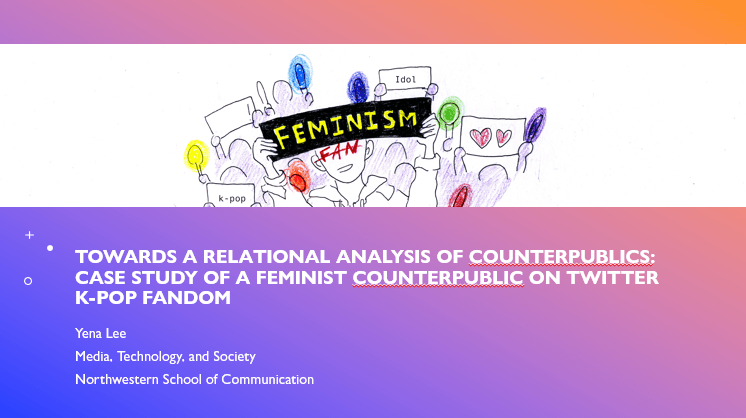
Counterpublic research highlights the significance of counter-discourse in challenging dominant public spheres. Yet, less focus has been given to how counterpublic actors could destabilize the relationships within a dominant public to foster counter-discourse. I examine the creation of a feminist counterpublic within Twitter K-pop fandom to understand how oppositional actors can transform the toxic technocultures of the dominant public to create a counterpublic. Formed by feminist K-pop fans, this counterpublic defied toxic relational norms of the mainstream K-pop fandom, cultivating a culture where fans could critique problematic K-pop star text without renouncing their fan identity. I bring the concepts of relational schemas and scripts to the study of counterpublics to demonstrate how creating an alternative schema can be a tool of resistance. To do so, I highlight how feminist fans reappropriated existing relationship scripts and formulated new ones to modify the relational schema of the mainstream K-pop fandom. I argue that these relational strategies helped feminist fans regroup by creating opportunities for productive coexistence, facilitating an alternative relational schema around a critical fan identity.
Lee, Y. (2023). Toward Productive Coexistence: A Relational Analysis of a Feminist Counterpublic in Twitter K-Pop Fandom. International Journal of Communication; Vol 17 (2023). https://ijoc.org/index.php/ijoc/article/view/20439
Social movement leadership brokerage

With recent research emphasizing different leadership roles that characterize networked social movements, brokerage has received renewed attention as one of the key responsibilities of networked movement leadership. However, in limiting the role of brokering to creating horizontal connections among decentralized actors, previous research is missing an account of grassroots movements that were able to make vertical connections with the power structures and grow to have a significant political impact. By comparing two cases of feminist networked social movements from South Korea, I examine brokerage and conditions that enabled brokerage through the lens of leadership. I argue that brokerage is a crucial dimension of movement leadership and propose the concept of meso-level leadership to elaborate how some grassroots leaders could facilitate grassroots representation in mainstream legislative agenda-setting by forming relationships with actors across a broad organizational and institutional spectrum.
Lee, Y. (2023). Meso-level leaders as brokers of horizontal and vertical linkages in feminist networked social movements. Information, Communication & Society, 26(10), 2015–2032. https://doi.org/10.1080/1369118X.2022.2065212
 Yena Lee